
Listen.
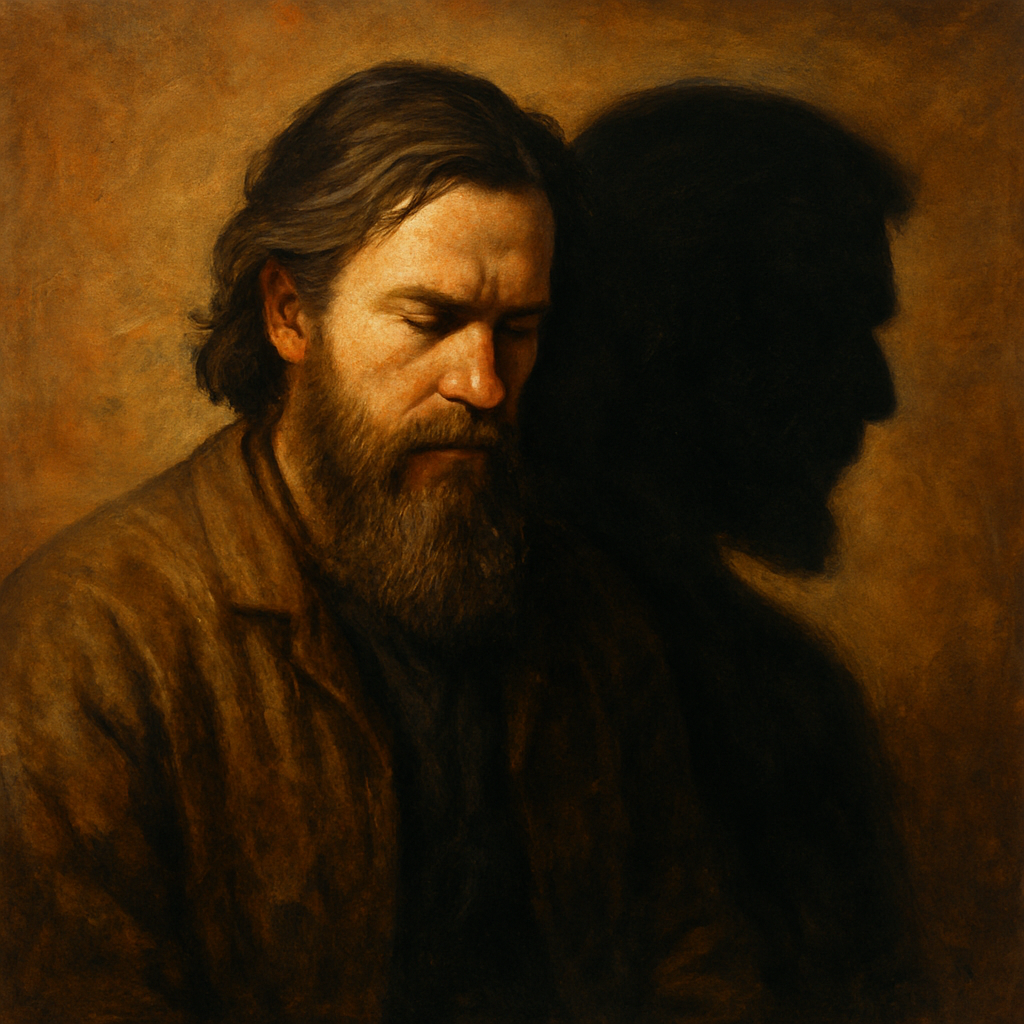
Come a little closer to the fire. Yes—right there. I want to tell you a story about an old friend of mine. He’s followed me since childhood, kept pace with me across continents, sat beside me in temples and train stations, stared back at me from polished teapots and puddles alike. He has whispered things I didn’t want to hear, and held truths I wasn’t ready to claim.
You have one too, of course.
We all do.
We just call it different things. Some call it conscience. Some call it trauma. Some call it “that thing I don’t want to think about right now.” Carl Jung, who had the rare talent of being both scientist and mystic without needing to apologize for either, called it the Shadow: the parts of ourselves we exile because we think they are unworthy, unlovable, or inconvenient.
But the Shadow never disappears. It walks a step behind you, patient as stone, waiting for the moment you finally turn around.
The Shadow Isn’t the Enemy—It’s the Storage Room
In psychology, the Shadow contains the pieces of ourselves we reject. Anger that wasn’t allowed. Grief that was never named. Talents we were told weren’t “ours.” Even joy, when the world taught us it was dangerous to shine.
Think of the mind as a grand old house. The Shadow is the room where you toss boxes marked “deal with later.” The problem is that “later” has a habit of leaking.
You know the feeling:
You snap at the barista because your boss wasn’t listening.
You freeze in a moment that calls for bravery because once, long ago, you weren’t safe to speak.
You meet someone and instantly love or hate them without knowing why—Jung called this projection, the mind’s way of saying, “Here, hold this for me. I can’t quite carry it yet.”
Shadow work is simply the process of unlocking the door and sorting the boxes before they topple.
Not exorcising demons—understanding them.
Not slaying dragons—learning why they were guarding the treasure in the first place.
Why a Wizard Cares About Psychology
People think I spend my days reading tea leaves and deciphering ancient symbols, and yes, I do—but the real work is helping people read themselves. Symbolism is only a language; the conversation is always inward.
Shadow work lives in that same place: the borderland where story, memory, pattern, and psyche meet.
In my travels, I sat with monks who spoke of the “Hungry Ghost,” tribes who spoke of “the Unlived Life,” neuroscientists who spoke of “implicit memory,” and therapists who spoke of “repressed affect.” Different dialects of the same truth:
The parts you refuse to face end up running your life from behind the curtain.
It’s not magic.
It’s not psychology.
It’s both, cross-pollinating in the quiet corners of the mind.
Shadow Work Isn’t About Fixing—It’s About Integrating
There is a misconception that shadow work means digging up every painful memory like a grave robber with a lantern. No. That’s how you get lost.
Shadow work is gentler. More curious. Less dramatic.
Think of it as sitting down with the version of you who didn’t get what they needed at the time—and finally listening.
Ask your Shadow:
What are you trying to protect me from?
What did you learn back then that you still believe now?
What am I avoiding because I’m afraid of becoming someone I once feared?
And the Shadow, relieved to be acknowledged, will answer.
Sometimes it sounds like a whisper.
Sometimes it sounds like a scream.
Sometimes it sounds like the truth you have avoided for far too long.
But always—it brings you home.
The Science of Consciousness and the Magic of Being Honest
Jung believed the psyche is self-regulating, always trying to bring what’s unconscious into consciousness to restore wholeness. Modern neuroscience agrees: the brain is wired to resolve tension between what we feel and what we admit.
Avoidance is expensive.
Emotion takes energy.
The Shadow is simply an overburdened ledger waiting for accounting.
When you do shadow work, cortisol drops. Neural pathways loosen. The amygdala—the fear center—finally stops shouting long enough for the prefrontal cortex to figure out what the hell is going on. You reclaim executive function from emotional autopilot.
You become, in a very real way, more you.
This is why ancient rituals worked. Why storytelling, confession, divination, journaling, meditation—they all work. They give the mind a shape in which to pour unspoken truths until they can be carried consciously.
The ritual doesn’t create the healing.
It creates the container for the healing.
Walking with Your Shadow Instead of Outrunning It
One of the most dangerous beliefs a person can hold is: “I should be over this by now.”
No. Healing does not obey clocks, calendars, or your internal project manager. The Shadow is not a task; it is a relationship. The goal isn’t to defeat it, but to walk in partnership with all parts of yourself—especially the inconvenient ones.
Because here’s the secret the old mystics and the modern scientists somehow agree on:
Your Shadow holds half your strength.
Your creativity lives there.
Your intuition lives there.
Your boundaries, your truth, your fire—they live there too.
You don’t become whole by cutting pieces off.
You become whole by welcoming them back.
A Final Cup of Tea Before You Go
If we were sitting together now—steam curling between us, sunlight catching the rim of the cup—I would tell you this:
Your Shadow is not your flaw.
It is your unfinished story.
And like all good stories, it deserves to be read, understood, and honored.
When you walk with your Shadow, you walk with your full self.
When you listen to it, you reclaim the power you once handed away.
And when you integrate it, you finally become the person you were trying so hard to pretend you already were.
So tonight, when the world is quiet, sit with your Shadow.
Not as an adversary.
As an old friend who waited patiently for you to turn around.
I promise—there is nothing in that darkness that does not, in some strange and holy way, belong to you.
And you are allowed to come home to yourself.
~MacBayne


0 Comments