
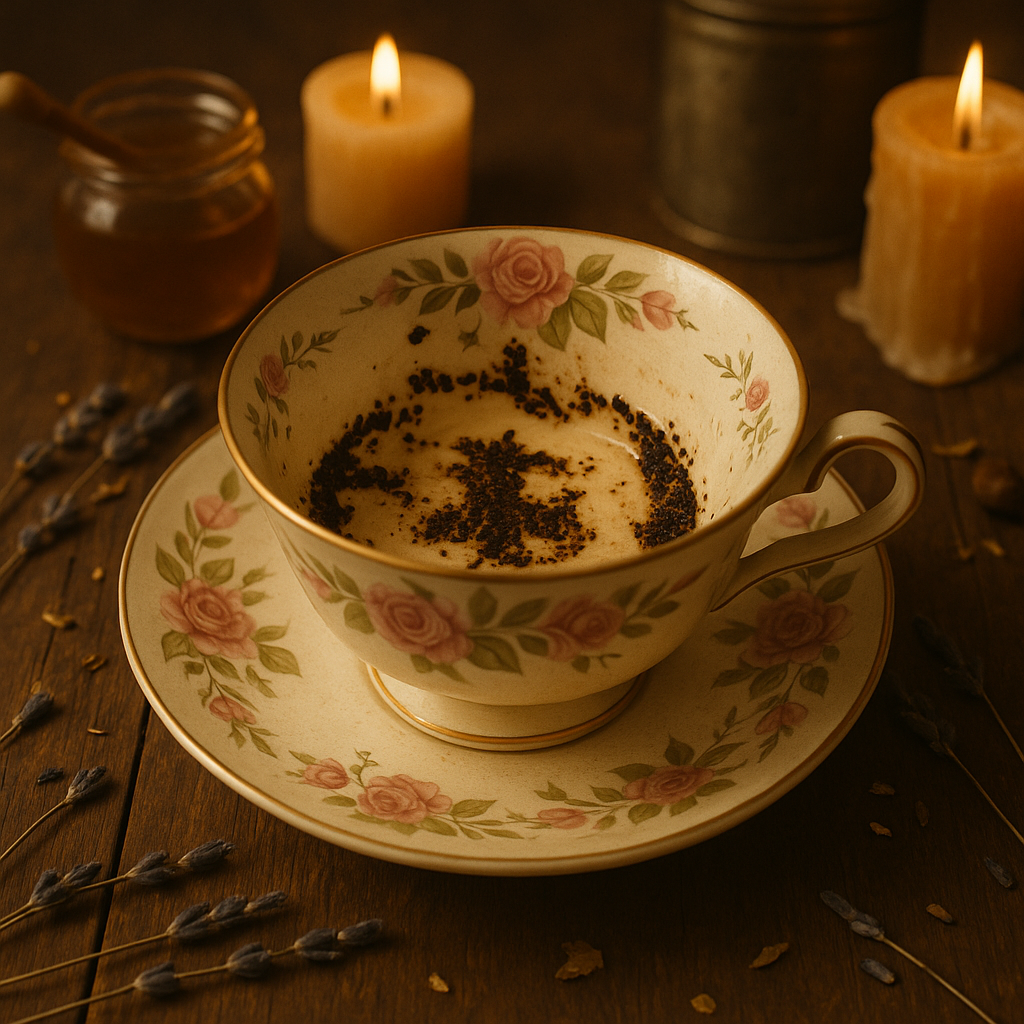
A Practical Mystic’s Guide to Finding Meaning in Yesterday’s Earl Grey
Let’s be honest: if you own more crystals than forks and have ever sage-smudged a Wi-Fi router after a particularly chaotic Mercury retrograde, then the idea of finding messages in damp leaves at the bottom of a cup isn’t that far-fetched.
I’ve tried the usual paths to enlightenment — meditation apps, journaling, mirror-staring, breathwork — and at some point I realized something profound: reading tea leaves makes just as much sense as anything else we do to figure out life.
Maybe more.
When the Teacup Knows More Than the Therapist
Tasseography — yes, we’re using the serious name because it feels more official than “staring at wet leaves until they resemble destiny” — is the ancient practice of reading patterns formed by leftover tea, coffee grounds, or wine sediment.
(And truly, if you’ve got leftover wine, that may be the real omen.)
Tea-reading appeared in medieval Europe, though the Chinese likely explored it long before — understandable, considering they invented tea and therefore had a generous head start in staring thoughtfully into cups. The Victorians later adopted it with theirusual flair for séances, spirit photography, and pseudoscientific forehead-palpation. They seemed determined to ask the universe questions by any method that wasn’t simply asking themselves.
Symbols: The Language We Already Know
Here’s where things shift from charming superstition to quietly compelling: the symbols that appear in your cup aren’t random. They come from a shared catalogue of human meaning — a collective unconscious full of archetypes we’ve carried through centuries.
Some common symbols:
- Birds — Message, perspective, or the suggestion you may need fresh air
- Circles — Completion, wholeness, recurring self-improvement cycles
- Trees — Growth, stability, or guilt about the houseplant you definitely over-watered
- Mountains — Challenges or the administrative tasks you keep avoiding
- Snakes — Renewal, healing, or a subtle reminder about boundaries
These symbols resonate because they speak to universal concerns: love, fear, transformation, uncertainty.
We already know the language. The leaves simply hold up the mirror.
The Ritual
A gentle guide:
- Brew real loose-leaf tea.
Bags are fine for convenience — but ritual thrives where intention lives.
- Drink slowly.
Let the warmth soften your thoughts. Let the moment become still.
- Leave a teaspoon of liquid.
Enough to move the leaves, not enough to drown them.
- Swirl three times counterclockwise.
Not because the universe demands it — but because ritual anchors meaning.
- Invert the cup onto the saucer.
Let the pattern settle. Let your mind settle with it.
- Observe. Not with urgency — with curiosity.
The Geography of a Cup
A teacup is a map:
- The rim — the present and immediate future
- The sides — near-future influences
- The bottom — long-term patterns and deeper subconscious territory
- The handle — the self
- Opposite the handle — outside forces, other people, unseen influences
The world inside the cup becomes a gentle reflection of the world inside you.
Does It Tell the Future? Or Does It Tell the Truth?
Here’s the quiet magic:
Tasseography works not because the leaves know your fate — but because you do.
We are beings wired for meaning. When you see a mountain, a key, a ladder, a letter — it isn’t destiny whispering.
It’s your subconscious finally speaking loudly enough for you to hear.
It’s a beautifully ancient version of a Rorschach test — with better fragrance and significantly more ceremony.
Why We Keep Returning to the Cup
In a world of data analytics, notifications, algorithms, and optimization — tea asks something radically simple of you:
Slow down. Sit with yourself. Listen.
There is something deeply comforting in that.
Something sacred in the absurdity.
The Final Sip
So will reading leaves grant you psychic certainty?
No — and thank goodness. Life would be exhausting if the ending was already written.
But will it give you space to reflect, to notice your inner landscape, to acknowledge hopes and fears that rarely surface in the rush of daily life?
Absolutely.
And sometimes, that quiet moment with a cup of tea tells you far more than certainty ever could.
So go ahead: brew the tea. Swirl the leaves.
Let the universe — or perhaps more accurately, your inner wisdom — speak.
And if anyone questions it, smile gently and say:
“It’s a mindfulness ritual with symbolic reasoning and centuries of cultural history.”
Or, if needed:
“Mercury’s retrograde.”
Both answers work.


0 Comments